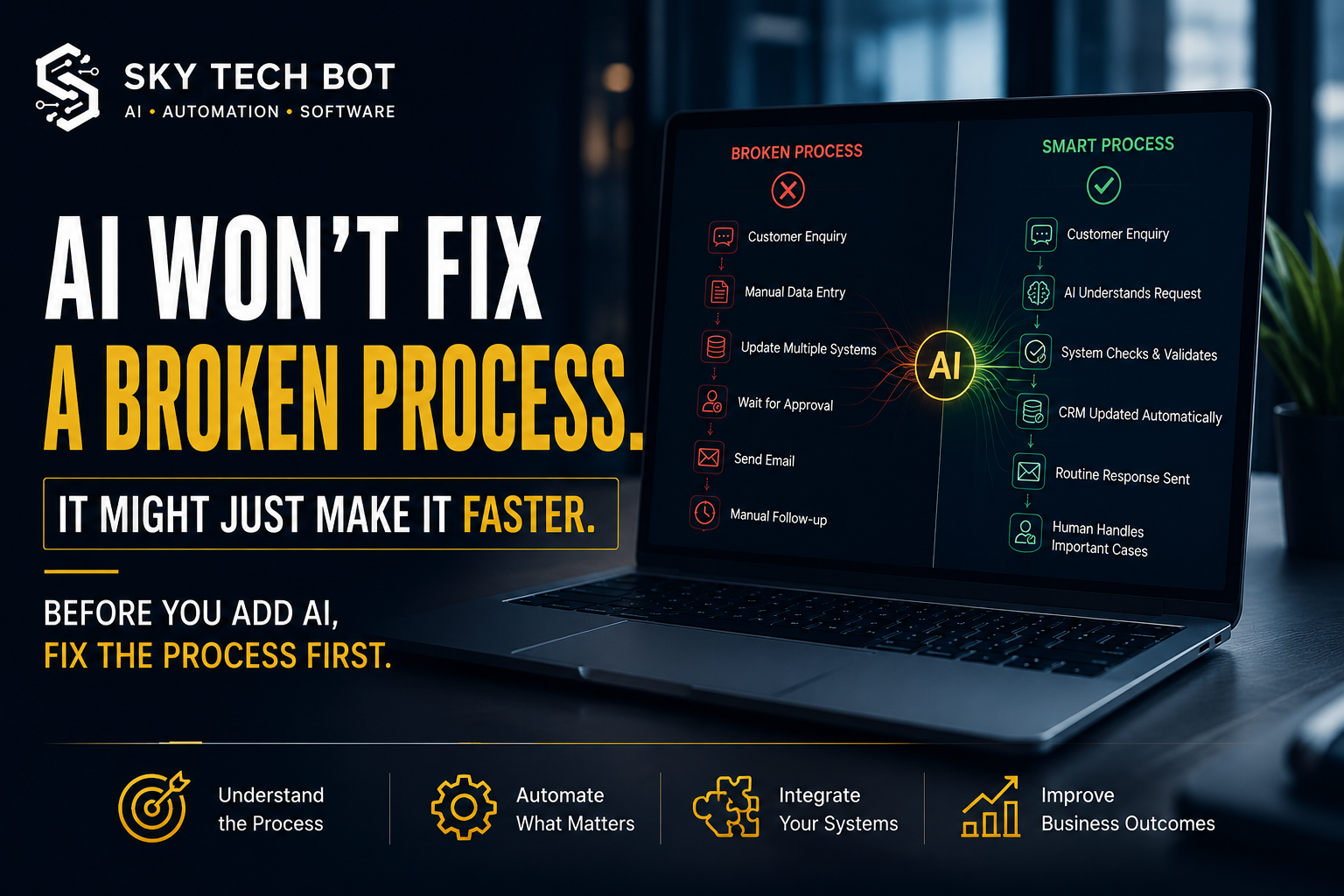
A customer enquiry arrives. An employee checks WhatsApp, copies details into Excel, updates the CRM, waits for approval, sends an email, and follows up manually.
Now imagine adding AI to this process.
The AI might read the enquiry faster. It might draft a response instantly. It might even update the CRM automatically.
But the employee is still checking WhatsApp. Still copying data. Still waiting for approvals.
The process remains complicated. AI just made one small piece of it faster.
This is the gap most businesses miss. They assume AI will fix inefficiency. In reality, AI amplifies whatever process it touches—good or bad.
Why Adding AI Doesn’t Automatically Improve a Business Process
AI is powerful. It can analyze data, generate content, and make decisions. But it doesn’t understand how your business operates. It doesn’t know which steps are unnecessary. It doesn’t question whether an approval is needed. It doesn’t stop to think: Is this the right way to do things?
That’s not what AI does.
AI follows instructions. It takes a given task and performs it with speed and scale. If the task itself is inefficient—part of a broken process—AI simply makes that inefficiency faster.
PwC’s US CEO Paul Griggs put it bluntly: if you layer AI on messy processes, it will only show you how messy they are. The technology won’t rescue a business already running badly.
Think of it this way. A train on aging tracks. You can buy the fastest train in the world, but it’s still limited by the tracks beneath it. AI is the train. Your business processes are the tracks.
AI is not a transformation engine. It is an amplifier. It multiplies what it finds—both strengths and weaknesses.
The Difference Between AI and Business Automation
These terms get mixed up constantly. Understanding the distinction is critical for deciding where to invest.
AI can understand, generate, classify, summarize, or make recommendations. It processes unstructured information. It handles content and context. It figures out what a customer is asking. It extracts data from a document. It decides if an enquiry needs human attention.
Automation moves work through a defined workflow. It connects actions. It updates a CRM when a condition is met. It sends a notification. It routes information to the right person. It performs tasks that follow clear rules.
The strongest business solutions combine both. AI handles the tasks that require understanding. Automation handles the tasks that require action. But before either can work effectively, the process itself needs to be defined and simplified.
A Simple Example of AI Workflow Automation
Consider a customer enquiry process. Without AI or automation, it might look like this:
- Email arrives
- Employee reads it
- Checks product information manually
- Copies details into a spreadsheet
- Forwards to a colleague for approval
- Waits for response
- Drafts a reply
- Sends it
Now imagine this instead:
The enquiry arrives. AI understands what the customer is asking. It checks relevant data. It updates the CRM automatically. It generates a routine response. If the enquiry is complex or urgent, it routes the case to a human.
This approach is better than simply adding a chatbot. A chatbot might reply quickly, but it doesn’t fix the underlying workflow—the manual steps, the disconnected systems, the delays.
When you combine AI with a redesigned workflow, you remove unnecessary work. You don’t just speed it up.
Signs That Your Business Process Needs Fixing First
Before you add AI, look for these warning signs in your current workflows:
- Employees entering the same information into multiple systems
- Too many spreadsheets being used as makeshift databases
- Manual copy-paste work between applications
- Repeated approval steps that add little value
- Multiple disconnected systems that don’t share data
- Frequent follow-up tasks that should be automated
- Work processes that depend on one employee’s knowledge
- Customers waiting too long for routine responses
If any of these sound familiar, AI isn’t your first priority. Fixing the process is.
What Businesses Should Automate First
Not every task needs AI. Many business processes benefit more from simple automation—defined workflows that reduce manual effort.
Consider these categories for automation:
- Repetitive data entry – Moving information between systems manually is inefficient and error-prone
- Customer enquiry handling – Routine questions can be handled without human involvement
- Internal notifications – Alerts when something needs attention
- Document processing – Routing, storing, and tracking documents
- Reporting – Compiling and distributing regular reports
- CRM updates – Recording interactions and progress
- Scheduling – Meetings, appointments, and follow-ups
- Routine follow-ups – Checking in with customers or stakeholders
Automation alone can eliminate a significant amount of busywork. AI can then be applied to tasks that genuinely need intelligence.
Where AI Adds the Most Value
AI is not the answer to everything. But it is exceptionally good at certain tasks.
Here are the use cases where AI makes the biggest difference:
- Understanding unstructured information – Interpreting free-text enquiries, emails, or chat messages
- Customer communication – Generating appropriate, personalized responses
- Document classification – Categorizing documents or routing them correctly
- Summarization – Condensing long documents, emails, or conversations
- Data extraction – Pulling key information from forms or unstructured text
- Recommendations – Suggesting products, responses, or next steps
- Intelligent routing – Deciding where to send complex or time-sensitive cases
AI shines when a task requires comprehension, judgement, or generation. It does not shine when the process itself is unclear.
Why Business Context Matters
AI doesn’t automatically understand your business. It needs context. It needs access to your:
- Business rules and policies
- Existing workflows
- Customer information and history
- Approval logic and hierarchy
- Connected software systems
- Known exceptions and edge cases
A generic AI tool—no matter how advanced—can’t replace this knowledge. It can only work with what you give it. If the underlying data is messy or the workflows are poorly defined, the results will reflect that.
As one leadership expert noted, the central mistake is treating AI as a technology project rather than a systems intervention. The leader’s task is to prepare the system for AI, not just to implement the technology.
AI + Automation + Custom Software
Adding another standalone AI tool is rarely the solution. Most businesses need a combination of approaches:
- AI for tasks that need understanding, generation, or decision-making
- Automation for defined workflows and rule-based actions
- Custom software for unique business processes that off-the-shelf tools can’t support
This is where integration becomes critical. AI needs to connect to your existing systems. Automation needs to trigger the right actions. Custom software bridges the gaps that generic tools leave behind.
Think of it this way: AI provides intelligence. Automation provides action. Custom software provides the connective tissue that makes both work together.
5 Questions to Ask Before Adding AI
Before investing in AI, ask these questions. They’ll help you avoid the trap of automating inefficiency.
- 1. What problem are we actually solving? – Be specific about the business outcome you need
- 2. How does the current process work? – Map it end-to-end before you change anything
- 3. Which steps are repetitive? – These are candidates for automation, not necessarily AI
- 4. Which decisions require human judgment? – These are where AI might help
- 5. What systems need to communicate with each other? – Integration is often the real challenge
When AI Automation Makes Sense
AI-powered automation is worth pursuing when you can answer these questions with confidence:
- The process is well-defined and understood
- There is a clear problem to solve (not just “we should use AI”)
- The expected value outweighs the implementation cost
- You have clean, accessible data to work with
- Your existing systems can connect to AI tools
- You have the internal capacity to manage the change
When these conditions are met, AI can deliver significant improvements. It can reduce manual effort, speed up response times, and improve decision-making.
When AI Is NOT the Right Answer
There are many situations where AI is not the best solution. Being clear about these helps you avoid expensive mistakes.
- If the process itself is unclear – Define it first
- If your data is poor quality – Fix your data first
- If the workflow changes constantly – AI struggles with constant change
- If the problem can be solved with simple automation – Don’t overcomplicate
- If the expected value is too low – Not every process needs AI
Sometimes the most effective solution is a well-designed workflow with simple automation. Sometimes it’s custom software. Sometimes it’s just cleaning up an existing process.
AI is a tool. It should be used where it adds value, not because it’s fashionable.
How Sky Tech Bot Approaches AI and Automation
At Sky Tech Bot, we take a practical approach to AI, automation, and software. We don’t start with the technology. We start with the workflow.
First, we map how work actually happens. We look at the systems involved, the manual steps, the bottlenecks, and the repeated tasks. Only then do we consider where AI could help, where automation could remove manual work, and where custom software might be needed to connect the gaps.
Our focus is on real business workflows—not flashy AI features. We build solutions that reduce unnecessary work. We integrate with the tools you already use. And we design for the long term, not just for a quick demo.
If you’re considering AI automation, we’d welcome the opportunity to talk. We can help you figure out whether your business process is ready—and what to do if it’s not.
Learn more at skytechbot.com.
Don’t Ask Where AI Can Be Added. Ask Where Unnecessary Work Can Be Removed.
AI is not a shortcut. It’s not a magic fix. And it certainly won’t turn a broken process into a good one.
The most successful companies are not the ones with the most advanced AI. They are the ones that have taken the time to redesign their workflows, clean up their data, and build systems that AI can actually work with.
AI should not simply make a complicated process faster. It should help make the process better.
Before you add AI, ask yourself: are you speeding up the right work? Or are you just making the wrong work faster?
Frequently Asked Questions About AI Business Process Automation
Can AI fix a broken business process?
No. AI cannot fix a broken business process on its own. It can speed up individual tasks, but if the underlying workflow is inefficient, AI will simply make the inefficiency faster. The process needs to be redesigned first.
What is AI workflow automation?
AI workflow automation combines AI capabilities with defined workflows to handle tasks that require both understanding and action. AI processes unstructured information, while automation moves work through the workflow based on defined rules.
What is the difference between AI and automation?
AI understands, generates, and makes decisions based on context. Automation follows predefined rules to move work from one step to the next. They are complementary: AI provides intelligence, automation provides action.
What business processes should be automated first?
Start with repetitive tasks like data entry, customer enquiry handling, internal notifications, document processing, reporting, CRM updates, scheduling, and routine follow-ups. These are areas where automation can have an immediate impact.
How can AI improve business workflows?
AI improves workflows by handling tasks that require understanding, classification, or generation. It can read customer enquiries, extract key information, generate responses, route complex cases to humans, and provide recommendations.
Does every business need AI automation?
No. Many businesses benefit more from simple automation or process redesign than from AI. AI is most useful when a process is already well-defined and the task requires intelligence rather than just rules.
When should a company build custom software?
Custom software makes sense when your business process is unique and off-the-shelf tools don’t support it effectively. It’s also valuable for integrating AI and automation across multiple systems in a way that generic tools can’t achieve.
How can businesses combine AI with automation?
AI and automation can be combined in a workflow where AI handles the understanding and decision-making steps, and automation handles the action and routing steps. The strongest solutions integrate both into a single process.
Discover more from Sky Tech Bot
Subscribe to get the latest posts sent to your email.