A business can spend thousands on AI and still have the same workflow problems it had before.
Why?
Because sometimes the problem isn’t the lack of AI.
It’s the process.
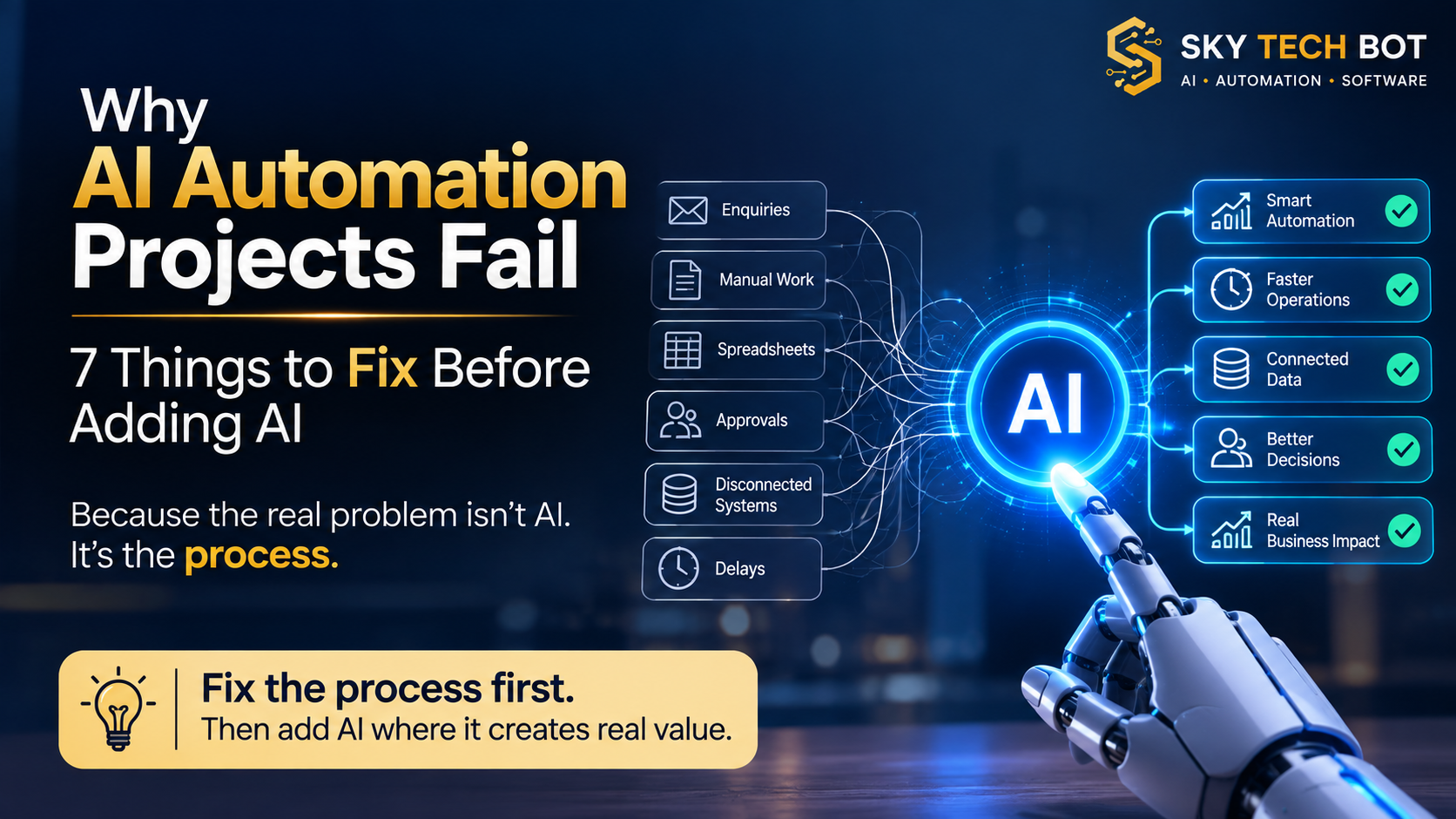
Consider a typical company that receives 100 customer enquiries daily. An employee reads each enquiry. Someone copies the information into a spreadsheet. Someone else updates the CRM. Another person asks a manager for approval. Someone sends the response. Someone follows up later.
Then management decides to add AI. They invest in a chatbot or an automated response system. But the employee is still copying data. Still waiting for approvals. Still switching between systems.
The AI made one small piece of the process faster. The overall workflow remains just as complicated.
This is the gap most businesses miss. They assume AI will fix inefficiency. In reality, AI amplifies whatever process it touches—good or bad.
Before implementing AI automation projects, it pays to look closely at what already exists.
AI Doesn’t Automatically Fix a Bad Process
AI is powerful. It can analyze data, generate content, and make decisions. But it doesn’t understand how your business operates. It doesn’t know which steps are unnecessary. It doesn’t question whether an approval is needed.
That’s not what AI does.
AI follows instructions. It takes a given task and performs it with speed and scale. If the task itself is inefficient—part of a broken process—AI simply makes that inefficiency faster.
Think of it this way. A train on aging tracks. You can buy the fastest train in the world, but it’s still limited by the tracks beneath it. AI is the train. Your business processes are the tracks.
This distinction matters because AI automation projects often fail not because the technology is flawed, but because the underlying workflow was never ready.
7 Things to Fix Before Adding AI
1. The Process Is Not Clearly Defined
When different employees perform the same task differently, confusion follows. Some people use email. Others use WhatsApp or spreadsheets. Processes remain undocumented. Ownership is unclear. No one can explain exactly how work moves from start to finish.
Before adding AI, map the process. Write down every step. Identify who does what. Clarify handoffs. Define what success looks like at each stage. This is called process mapping. It’s tedious but essential.
As one observer put it, “Automate chaos, get bigger chaos” . AI can’t bring order to a process that isn’t clearly defined.
2. Business Data Is Scattered
Data lives everywhere. Excel files. CRM systems. Email inboxes. WhatsApp chats. ERP platforms. PDFs. Internal databases. Disconnected information creates massive challenges for AI.
AI can work with fragmented data, but only if integration and data access are designed properly . According to one recent study, 56% of leaders describe data reliability as a key barrier to advancing AI projects .
Before implementing AI, create a single source of truth for critical business data. Standardize how data is captured and stored. Validate fields. Enforce consistent formats. Eliminate duplicates .
3. Too Many Manual Handoffs
Work often moves from Employee → Manager → Finance → Operations → Customer. Each handoff introduces delay and potential errors. Information gets lost. People wait for responses. Tasks stall.
AI can’t eliminate handoffs that aren’t necessary. But it can help when workflows are designed to minimize unnecessary handoffs.
Assess every handoff. Ask: Is this step essential? Can information be shared automatically? Can decisions be made earlier? Simplifying the flow before adding AI yields better results.
4. Business Rules Are Not Clearly Defined
Automation needs clear rules. Examples include: If a customer is new, send for review. If a request meets criteria, process automatically. If the request is sensitive, send to a human.
There’s a difference between deterministic business rules and AI-based reasoning. Deterministic rules are black and white. They can be coded in simple automation. AI is useful when situations are less clear-cut.
Without defined business rules, even the most advanced AI will struggle to make the right decisions.
5. AI Is Not Connected to Existing Business Software
An AI chatbot by itself is not the same as business automation. Real workflow improvement requires integration. AI must connect through APIs to your CRM, databases, ERP, internal applications, and workflow systems.
Consider a simple architecture:
- AI → API → Business System → Database → Workflow → Human Approval
Each link matters. If any connection is weak or missing, the automation fails. AI cannot create value in isolation. It must interact with the systems where your business operates .
6. Nobody Has Defined Where Humans Should Stay Involved
Human-in-the-loop automation is essential in many contexts. Situations involving money, sensitive information, unusual cases, high-value customers, or legal and compliance-sensitive decisions require human judgment.
Good automation doesn’t mean removing humans from every step. It means keeping people where they add the most value. Routine tasks can be automated. Complex decisions should involve human expertise.
Design workflows with clear escalation paths. Bring a person in when the AI’s confidence is low, or when the outcome could harm a relationship or compliance .
7. Success Has Not Been Defined
Businesses should decide what improvement actually means before implementing AI. Possible metrics include response time, processing time, manual hours, error rate, customer waiting time, operating cost, conversion rate, or number of manual steps.
Measuring the baseline before automation is important. Without a benchmark, you can’t tell whether AI has made a meaningful difference.
As one expert noted, if a project is just a novelty looking for a use case, it should be killed immediately . Real success comes from solving real business problems, not from implementing AI for its own sake.
The Better Way to Approach AI Automation
Here’s a practical framework for improving AI workflow automation in your business:
STEP 1 — Understand
Map the current process. Document every step, system, and handoff. Talk to the people doing the work. They know where the inefficiencies are.
STEP 2 — Simplify
Remove unnecessary steps. Combine tasks where possible. Eliminate duplicate data entry. Simplify approval chains. Streamline the flow before adding any technology.
STEP 3 — Connect
Connect relevant systems and data. Ensure that information flows automatically between applications. Integration is often the real challenge in AI automation.
STEP 4 — Automate
Automate repetitive and predictable work. Use rule-based automation for tasks that don’t require intelligence. This reduces manual effort and creates a foundation for AI.
STEP 5 — Add AI
Use AI where language, classification, summarization, reasoning, or unstructured information genuinely adds value. AI handles tasks that require understanding, not just rules.
STEP 6 — Monitor
Measure the new workflow and improve it over time. Set-it-and-forget-it never works with AI . Models drift. Business rules change. Small errors compound into big failures.
Build dashboards that track automation performance—error rates, completion times, and human intervention frequency . Review AI outputs regularly and retrain models when needed.
A Simple Example of Better AI Workflow Automation
Let’s compare a customer enquiry process before and after proper workflow design.
BEFORE:
- Customer enquiry
- Employee reads email
- Copies information to Excel
- Checks CRM manually
- Waits for approval
- Writes response
- Updates CRM
- Manual follow-up
AFTER:
- Customer enquiry
- AI understands the request
- System checks relevant information
- Business rules are applied
- Routine cases are processed automatically
- Sensitive or unusual cases go to human review
- CRM is updated automatically
- Customer receives response
- Follow-up is triggered automatically
The objective is not to replace every human action. The objective is to remove unnecessary work while keeping appropriate human oversight. This approach reduces manual effort, speeds up response times, and improves decision-making.
When Should a Business Actually Use AI?
AI is particularly useful when workflows involve unstructured text, documents, customer conversations, classification, summarization, information extraction, natural-language interaction, pattern recognition, or decision support.
However, if the task is simply “IF X happens → DO Y,” traditional workflow automation is simpler and more predictable than AI. Use the right tool for the right job.
AI’s strengths include understanding context, handling ambiguity, and generating content. Rule-based automation handles deterministic tasks with clear logic. Combining both approaches is often the best path forward.
The best AI solutions for businesses are those applied to the right problems—not every problem looks like an AI problem .
AI Automation vs Traditional Automation
This comparison helps clarify when to use each approach:
| Aspect | AI Automation | Traditional Automation |
|---|---|---|
| Predictable Rules | Handles ambiguity and edge cases | Relies on fixed if/then logic |
| Unstructured Information | Processes text, images, and documents | Struggles with unstructured data |
| Human Decisions | Supports and augments human judgment | Follows deterministic rules only |
| Scalability | Scales with data and usage but requires tuning | Scales predictably with defined rules |
| Integration | Often complex, requires APIs and data pipelines | Can integrate through simpler connectors |
| Monitoring | Needs continuous evaluation and retraining | Requires checking for broken rules |
| Best Use Cases | Natural language, classification, summarization | Data entry, notifications, routing |
Common AI Automation Mistakes Businesses Should Avoid
Based on common patterns observed across industries, here are practical mistakes to watch for:
- Starting with the AI tool instead of the business problem – Tools should solve problems, not create them
- Automating a process nobody understands – Document the workflow first
- Ignoring data quality – Clean data is essential for reliable AI
- Forgetting system integration – AI needs to connect to existing systems
- Automating sensitive decisions without review – Keep humans in the loop where needed
- Measuring AI usage instead of business outcomes – Focus on results, not adoption metrics
- Expecting AI to work perfectly without monitoring – Continuous evaluation is required
As one industry expert noted, “Rushing into automation feels like progress. But speed without structure creates hidden costs” . The winners approach AI with a different mindset: solve one clear problem first, pilot small before scaling big, and involve employees as partners.
What Businesses Should Ask Before Implementing AI
Use this checklist to prepare for AI automation projects:
- What problem are we solving? – Be specific about the business outcome needed
- How does the current process work? – Map it end-to-end before changing anything
- Where is time being lost? – Identify bottlenecks and delays
- Which steps are repetitive? – These are candidates for automation
- Which decisions require humans? – Define where judgment is essential
- Where does the required data live? – Identify all data sources
- Which systems need to communicate? – Plan integration points
- What business rules must be followed? – Document all rules and exceptions
- What should happen when AI is uncertain? – Design fallback and escalation paths
- How will we measure success? – Define metrics before implementation
The Real Goal of AI Automation
The goal isn’t to add AI everywhere. The goal is to make a business process work better.
AI should be part of the solution, not the definition of the solution. When you start with the problem rather than the technology, you’re more likely to find the right answer—which may not be AI at all.
As one expert observed, “Automation is not a shortcut… it is an amplifier of what already exists. Fix the process first, then AI turns efficiency into measurable results” .
How Sky Tech Bot Approaches AI and Automation
At Sky Tech Bot, we take a practical approach to AI, automation, and software. We don’t start with the technology. We start with the workflow.
First, we map how work actually happens. We look at the systems involved, the manual steps, the bottlenecks, and the repeated tasks. Only then do we consider where AI could help, where automation could remove manual work, and where custom software might be needed to connect the gaps.
Our focus is on real business workflows—not flashy AI features. We build solutions that reduce unnecessary work. We integrate with the tools you already use. And we design for the long term, not just for a quick demo.
If you’re considering AI automation, we’d welcome the opportunity to talk. We can help you figure out whether your business process is ready—and what to do if it’s not.
Learn more at skytechbot.com.
Frequently Asked Questions
What is AI automation?
AI automation combines artificial intelligence capabilities with defined workflows to handle tasks that require both understanding and action. AI processes unstructured information while automation moves work through the workflow based on defined rules. The strongest solutions integrate both into a single process.
Why do AI automation projects fail?
AI automation projects typically fail because of underlying business process issues, not because of the technology itself. Common causes include poorly defined processes, scattered data, too many manual handoffs, undefined business rules, lack of system integration, unclear human involvement, and undefined success metrics. Fixing these issues before adding AI significantly improves success rates.
How should a business prepare for AI automation?
A business should prepare by mapping current processes, simplifying workflows, connecting relevant systems, defining business rules, identifying where humans add value, and setting clear success metrics. This foundation ensures that AI adds real value rather than simply accelerating inefficient processes .
Is AI better than traditional automation?
Not necessarily. Traditional automation is better for deterministic tasks with clear rules, such as “IF X happens → DO Y.” AI excels at tasks involving unstructured information, such as understanding customer enquiries, classifying documents, or generating responses. The best approach often combines both.
Can AI automate an entire business process?
Rarely. Most business processes benefit from a combination of AI, traditional automation, and human oversight. AI handles tasks requiring understanding and judgment. Automation manages rule-based actions. Humans oversee sensitive decisions and edge cases. Removing humans entirely is usually not practical or desirable.
What is human-in-the-loop AI automation?
Human-in-the-loop automation keeps people involved in critical decisions. AI handles routine tasks, but complex, sensitive, or unusual cases are escalated to humans. This approach is essential for situations involving money, sensitive information, legal compliance, or high-value customers .
How does AI integrate with existing business software?
AI integrates with existing business software through APIs and workflows. The AI system connects to your CRM, databases, ERP, and internal applications through these interfaces. Proper integration design ensures that information flows automatically between systems without manual data entry.
How can businesses measure AI automation ROI?
ROI should be measured by improvements in business outcomes, not by AI usage metrics. Track metrics such as response time, processing time, manual hours reduced, error rates, customer waiting time, operating cost, and conversion rates. Measure the baseline before implementing AI to quantify improvement.
Before Adding AI, Fix the Process First
AI is powerful. But the most valuable implementation is usually the one connected to a real business problem, a clear workflow, and a measurable outcome. Before asking where AI can be added, understand what the business actually needs to improve.
What business process would you improve first if you were given the opportunity to automate it today?
Discover more from Sky Tech Bot
Subscribe to get the latest posts sent to your email.