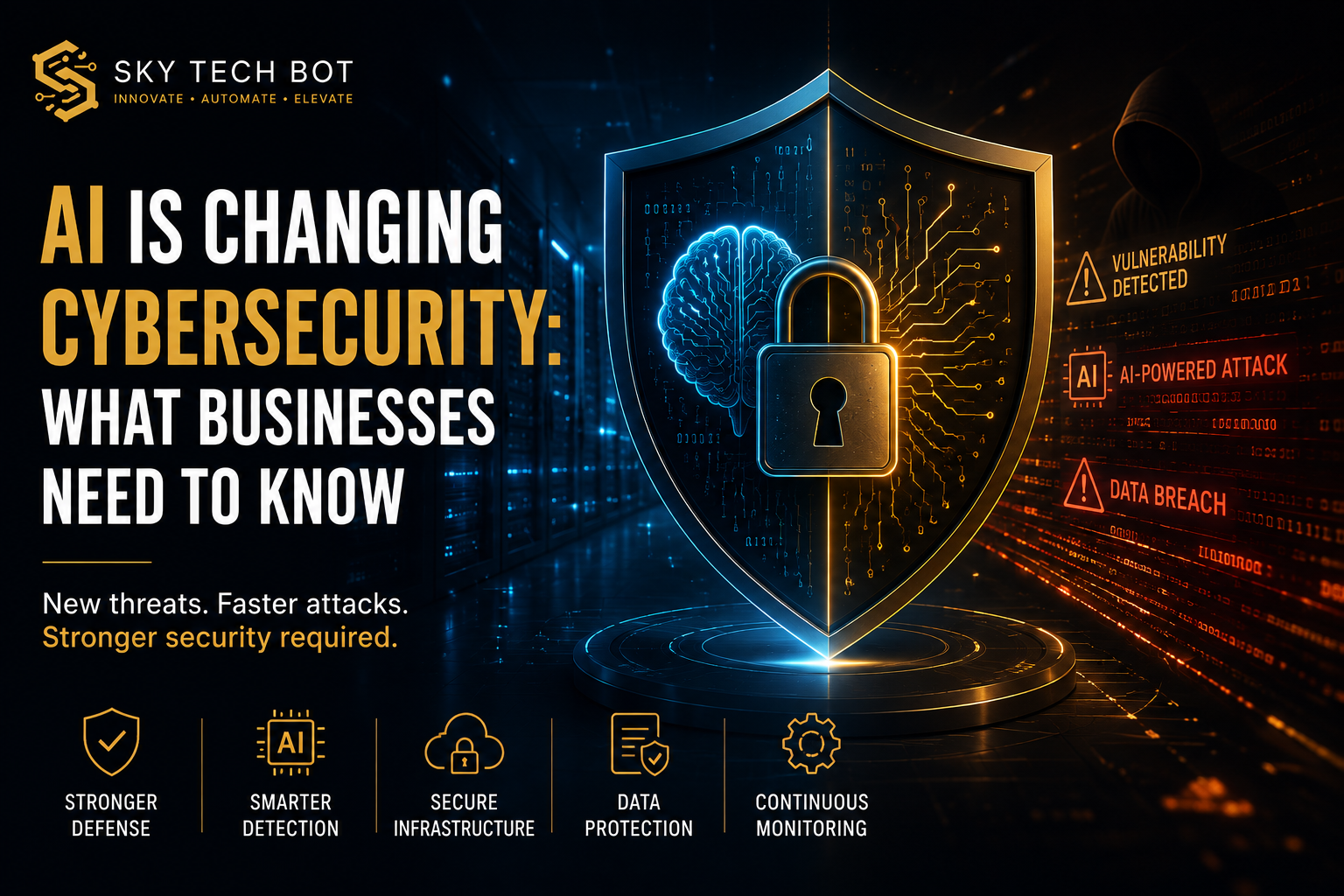
AI is not only changing how companies build software. It is changing how quickly security threats can develop. For years, the gap between discovering a vulnerability and seeing it exploited in the wild gave defenders a window to respond. That window is shrinking.
A recent enterprise security report highlighted that AI-driven tools are shortening the time between vulnerability disclosure and active exploitation, compressing what used to take weeks into days or hours. This is the new reality of AI cybersecurity: a faster, more complex threat landscape where the same capabilities that help teams analyze data and automate defenses can also be turned against them.
AI Has Changed the Speed of Cybersecurity
Traditionally, the lifecycle of a vulnerability—from discovery to weaponization to exploitation—could take months. Security teams had time to assess, patch, and communicate risks. AI-assisted analysis has compressed parts of that process significantly.
Consider vulnerability research. A human analyst might spend days poring over code to identify a subtle flaw. AI models, trained on vast datasets of known vulnerabilities and code patterns, can surface potential weak points in hours or minutes. The change is not simply that AI exists; the critical shift is speed, scale, and automation.
This doesn’t mean every vulnerability is instantly exploited. But it does mean the window for attackers to act has narrowed, and the pressure on defenders to respond has intensified. The question for businesses is no longer if AI will affect their security posture, but how quickly they can adapt.
The Same AI Can Help Defenders and Attackers
AI is a dual-use technology. Its capabilities are available to both sides of the security equation. Understanding this duality is essential for any modern security strategy.
Defensive Capabilities
- Pattern detection: AI excels at identifying anomalous behavior across millions of logs and network events.
- Security analysis: It can correlate seemingly unrelated alerts to uncover sophisticated attack chains.
- Log analysis: AI tools can parse and prioritize security logs, reducing alert fatigue.
- Automation: Routine tasks like patch management and incident triage can be accelerated.
- Faster investigation: AI-assisted search and summarization help security analysts get to root causes faster.
Potential Risks
- Faster vulnerability discovery: Attackers can use AI to accelerate reconnaissance and identify weak spots.
- Automated reconnaissance: AI can scan and profile systems at scale, finding entry points more efficiently.
- More scalable attack preparation: AI can help generate convincing phishing content or adapt malware to evade detection.
The key takeaway is not fear, but awareness. The same AI that powers your threat detection tools could be used by adversaries to probe your defenses. This symmetry makes AI-driven cybersecurity a priority for every organization, regardless of industry.
AI Is Increasing the Security Requirements for Businesses
Deploying AI workloads introduces new security demands that go beyond traditional IT. AI models, especially large language models and machine learning pipelines, handle vast amounts of sensitive data. This creates additional requirements around:
- Data protection: Training data and inference inputs must be secured throughout the lifecycle.
- Privacy: AI systems often process personal or proprietary information, increasing privacy risk.
- Compliance: Regulations like GDPR, HIPAA, and industry-specific frameworks apply to AI data processing.
- Data residency: Where data is stored and processed for AI workloads has legal and operational implications.
- Access control: AI platforms require granular IAM policies to prevent unauthorized access or model theft.
- Infrastructure security: The compute and storage underlying AI must be hardened like any critical system.
- Governance: Policies for model development, deployment, and monitoring need to be established and audited.
- Monitoring: AI systems introduce new telemetry and potential failure modes that require specific observability.
Companies cannot treat AI security as only a model-level problem. It is a data, infrastructure, and governance problem that demands cross-functional collaboration between security, engineering, and compliance teams.
Security Policies Are Not Enough
Many organizations have comprehensive security policies. They have acceptable use policies, data classification standards, and incident response plans. But there is often a gap between policy and enforcement.
Enforcement matters because security is not a one-time event. It is a continuous process of monitoring, adjusting, and responding. A policy that cannot be consistently enforced is little more than a document.
- Centralized policies: Consistency across cloud, on-premises, and hybrid environments is critical.
- Automated enforcement: Where possible, security controls should be embedded in infrastructure as code and CI/CD pipelines.
- Monitoring: Real-time visibility into compliance and threat posture helps identify gaps before they are exploited.
- Compliance readiness: Proactive audits and continuous assessments reduce the risk of regulatory penalties.
- Incident response: Policies must translate into actionable runbooks that can be executed under pressure.
As AI accelerates the pace of threats, manual enforcement becomes a liability. Businesses need to invest in systems that can operate at machine speed, not human speed, to close the enforcement gap.
What AI Means for Cloud and Infrastructure Security
Infrastructure decisions are foundational to securing AI workloads. Whether you are deploying models in the cloud, on-premises, or in a hybrid environment, the underlying architecture determines your security capabilities.
Key considerations include:
- Data protection: Encryption at rest and in transit, key management, and secure data sharing.
- Secure infrastructure: Hardened operating systems, network segmentation, and zero-trust principles.
- Access controls: Least-privilege access, just-in-time permissions, and regular privilege reviews.
- Isolation: AI workloads should be isolated from less critical systems to limit blast radius.
- Monitoring: Comprehensive logging and alerting for AI-specific events and anomalies.
- Recovery: Backup and disaster recovery strategies that account for model artifacts and training data.
- Compliance: Infrastructure must support regulatory requirements for data residency and auditability.
There is no one-size-fits-all answer. The appropriate architecture depends on the workload, security requirements, compliance obligations, budget, and operational needs. For some, a cloud security approach with managed services makes sense. For others, a private cloud with greater control over the stack may be preferable.
What is clear is that infrastructure choices are security choices. Treating them as separate decisions exposes the business to unnecessary risk.
5 Practical Steps Businesses Can Take
- Protect sensitive data: Classify and encrypt all data used by AI systems. Apply strict access controls and monitor for unauthorized access.
- Automate security enforcement: Embed security checks into your CI/CD pipelines for AI models and infrastructure. Automate compliance scanning and alerting.
- Monitor AI workloads continuously: Treat AI systems like production applications. Monitor for performance anomalies, data drift, and security events.
- Build security into the platform: Choose platforms and architectures that provide built-in security features, such as identity management, logging, and encryption.
- Prepare for faster incident response: Update your incident response plans to account for AI-specific threats. Conduct tabletop exercises and refine your runbooks.
Why Security Needs to Move With AI
AI development is moving quickly. New models, frameworks, and applications emerge weekly. Security cannot remain a manual afterthought. It must be integrated into every stage of the AI lifecycle, from ideation to deployment to ongoing operations.
Businesses need security controls that can operate at the same speed as modern software and AI workloads. That means automation, zero-trust principles, and continuous monitoring. Security teams should be embedded in AI projects from the start, not called in at the end.
The organizations that succeed in the AI era will be those that treat security as a feature, not a constraint.
Building an AI or Custom Software Product?
Companies developing AI applications, SaaS platforms, APIs, automation systems, custom software, or data-driven applications should consider security, scalability, and maintainability from the architecture stage. The foundation you build today determines your ability to adapt tomorrow.
At Sky Tech Bot, we focus on building practical technology solutions with attention to software architecture, automation, and scalable development. We work with teams to design systems that are secure by design, not bolted on later.
FAQ: AI and Cybersecurity
1. What is AI cybersecurity?
AI cybersecurity refers to the use of artificial intelligence to enhance security operations, threat detection, and response, as well as the risks and opportunities AI introduces to the broader security landscape.
2. How is AI changing cybersecurity?
AI is accelerating both defensive and offensive security capabilities. It enables faster vulnerability discovery, automated threat detection, and more sophisticated attack preparation, fundamentally changing the speed and scale of cyber risk.
3. Can AI be used by cyber attackers?
Yes. Attackers can use AI to automate reconnaissance, generate convincing phishing content, identify vulnerabilities faster, and adapt malware to evade detection. The dual-use nature of AI makes it a concern for defenders.
4. How can businesses secure AI workloads?
Secure AI workloads by protecting training data and inference inputs, enforcing least-privilege access, monitoring model behavior, encrypting data, and embedding security into CI/CD pipelines. Treat AI systems as critical production applications.
5. Why is AI governance important?
AI governance establishes policies for model development, data handling, compliance, and monitoring. It ensures that AI is used responsibly, securely, and in alignment with regulatory and business requirements.
6. Is private cloud always more secure than public cloud?
Not necessarily. Security depends on implementation, not location. Private cloud may offer more control, but public cloud providers invest heavily in security. The right choice depends on your specific risk profile, compliance needs, and operational capabilities.
7. What should businesses do before deploying AI?
Before deploying AI, assess your data protection practices, review compliance requirements, establish governance policies, evaluate infrastructure security, and ensure your incident response plans account for AI-specific risks.
AI Will Move Fast. Security Has to Keep Up.
AI is creating new opportunities for businesses, but it also changes the security equation. Companies need to think about AI, infrastructure, data, security, and governance as connected parts of the same technology strategy. Isolated approaches will leave gaps that attackers will find.
The pace of AI adoption shows no signs of slowing. Security controls that were adequate for traditional workloads may not scale to meet the demands of AI-driven systems. Organizations that invest in modern, automated, and integrated security today will be better positioned to handle the threats of tomorrow.
Is your current infrastructure ready for the speed of AI?
Discover more from Sky Tech Bot
Subscribe to get the latest posts sent to your email.