AI adoption is moving quickly. Businesses are investing in AI tools, automation, data platforms and intelligent workflows. But there is another challenge that is becoming harder to ignore: how do you make AI understand the way your business actually works?
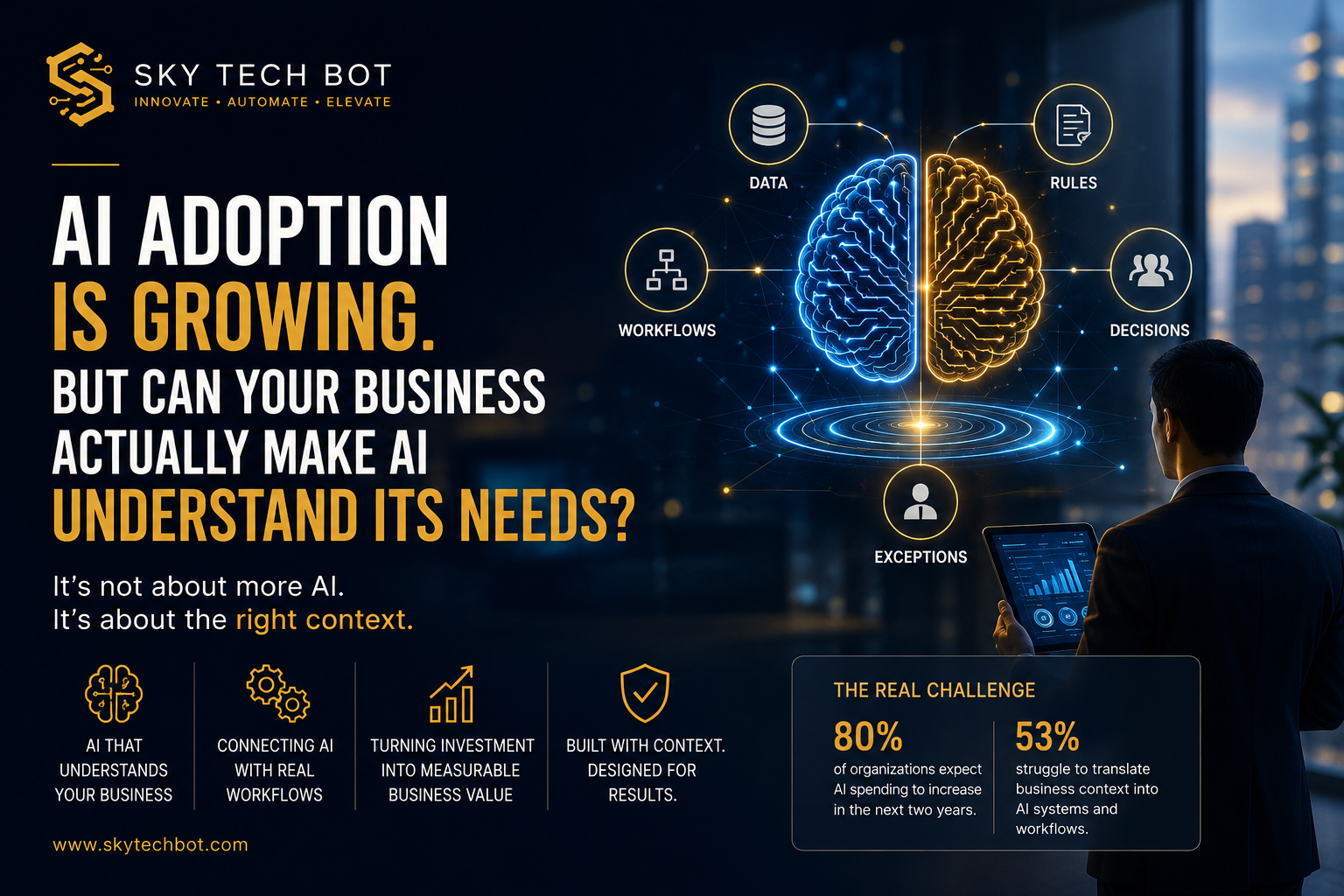
A recent 2026 research report from Alteryx highlights this gap. Among 1,400 technology leaders surveyed, 80% said they expect their organization’s AI spending to increase over the next two years. At the same time, 53% said their organizations struggle to translate business context into AI systems and workflows.
The numbers point to an important shift in the AI conversation. Businesses are no longer only asking whether AI can work. They are increasingly asking whether AI can deliver meaningful results inside the real processes of the business.
AI Is Getting More Investment. But Investment Alone Is Not Enough.
It is easy to look at the rapid growth of AI and assume that adding an AI tool is enough to create business value.
A company can add an AI chatbot to its website. It can connect an AI assistant to internal documents. It can automate parts of customer support. It can build an AI-powered application.
But the technology still needs to understand the environment in which it operates.
Every business has its own customers, processes, policies, approval rules, terminology, pricing structures, exceptions and operational decisions. These details are what make one business different from another.
That is why AI for business is not simply about connecting a powerful model to a large amount of data. The real challenge is connecting AI with the right business context.
What Does “Business Context” Actually Mean?
Business context is the information and logic that explain how an organization actually operates.
For example, imagine a company that receives hundreds of customer enquiries every week.
An AI system may be able to read those enquiries and generate responses. But the business may have specific rules about which customers receive discounts, when a refund can be approved, which issues need escalation, or which products can be recommended.
Those rules are part of the business context.
- Business rules: The policies and conditions that guide decisions.
- Workflows: The steps employees follow to complete a process.
- Customer information: The data required to understand individual customer needs.
- Operational knowledge: The practical knowledge employees use every day.
- Exceptions: Situations where the normal process does not apply.
- Decision criteria: The factors used to approve, reject or prioritize something.
Without this context, an AI system may produce technically impressive output without actually solving the business problem.
The Interesting Gap: AI Investment vs. AI Execution
The Alteryx research shows an interesting contrast.
- 80% of surveyed organizations expect AI spending to increase over the next two years.
- 69% reported moderate or significant ROI from their AI investments.
- 77% agreed that business context is important for accurate and relevant AI outputs.
- 53% said their organization struggles to translate business context into AI systems and workflows.
- Only 18% reported fully self-service access to cloud data for business users.
These findings suggest that businesses are willing to invest in AI, but turning that investment into repeatable business processes can be much harder.
The difficult part may not always be choosing an AI model. It can be connecting that model with the data, rules, systems and workflows that already exist inside the organization.
Why Adding AI to a Business Process Is Not the Same as Improving It
There is an important difference between adding AI and using AI effectively.
Suppose a company has a manual process that takes several hours every day. Adding an AI assistant that produces summaries may reduce some work.
But what happens after the summary is generated?
Does another employee still need to copy the information into another system? Does someone still have to manually approve the result? Does the AI know which cases need escalation? Can the system automatically trigger the next step?
This is where AI workflow automation becomes more interesting.
The goal is not simply to make AI generate something. The goal is to connect AI with the process so that it can contribute to a meaningful business outcome.
AI Needs More Than Data
Data is obviously important for AI. But more data does not automatically mean better business results.
A business may have customer databases, spreadsheets, documents, emails, reports and internal applications containing years of information.
The challenge is understanding which information matters, how it should be interpreted, and how it should influence a decision.
Consider a simple example.
A sales team may have thousands of customer records. An AI system can analyze those records and identify patterns. But the sales team may also know that certain customers are handled differently because of contract terms, business relationships or specific account conditions.
That knowledge may not be obvious from the database alone.
This is why successful business AI solutions need to consider data and business logic together.
Where Business Context Often Lives
One reason AI implementation can become difficult is that important business knowledge is often spread across different places.
- Spreadsheets
- Internal documentation
- CRM systems
- Email conversations
- Database records
- Existing software applications
- Process documents
- Employee knowledge and experience
- Approval procedures
- Operational policies
When this information is disconnected, building a reliable AI workflow becomes more complicated.
A good AI implementation therefore needs to look beyond the model itself and understand the systems around it.
AI Works Best When Business and Technology Work Together
One of the most important ideas highlighted by the research is the need for collaboration between technology teams and business teams.
The people who understand the business process are not always the people building the technology.
A business team may understand exactly why a particular approval is required. A developer may understand how to build the API that supports the process. A data team may understand where the required information is stored.
AI becomes much more useful when these perspectives come together.
The technology should not be built in isolation from the people who actually use the process.
What Businesses Should Consider Before Building an AI Solution
Before investing in a new AI system, businesses should start with the problem rather than the technology.
- Define the business problem: Identify the specific process, bottleneck or customer problem AI is expected to improve.
- Understand the existing workflow: Document how the process works today, including approvals, exceptions and manual steps.
- Identify the required data: Determine which systems and datasets are actually needed.
- Define business rules: Make important policies, thresholds and decision criteria clear before automating them.
- Choose the right AI approach: Not every problem needs a complex AI system. Sometimes automation, search, analytics or a simpler software workflow may be more appropriate.
- Integrate with existing systems: AI becomes more useful when it can work with the applications and data the business already uses.
- Measure the outcome: Define how success will be measured, such as time saved, reduced manual work, improved customer response or increased productivity.
AI Automation Should Solve a Real Business Problem
There is a temptation to add AI because everyone else is doing it.
But a business does not need AI everywhere.
It needs the right technology in the right places.
For one company, the biggest opportunity may be customer support automation. For another, it could be document processing. Another business may benefit more from an internal AI assistant, predictive analytics, workflow automation or a custom software platform with AI capabilities.
The right question is not:
“Where can we add AI?”
A better question may be:
“Which part of our business could work significantly better with the right technology?”
Custom AI Solutions vs. Generic AI Tools
Ready-made AI tools can be extremely useful. They can help businesses experiment quickly and solve common tasks without building everything from scratch.
However, some business problems are too specific for a generic tool.
A company may need AI to work with its own database, internal rules, customer records, APIs, software systems or approval processes.
In such situations, a custom AI solution or AI-powered software workflow may provide a better fit.
The decision should depend on the business problem, available data, security requirements, budget, integration needs and expected return—not simply on which AI technology is currently popular.
What This Means for Small and Growing Businesses
AI is not only relevant to large enterprises.
Small and growing businesses can also use AI to reduce repetitive work, improve customer communication, organize information and automate routine workflows.
But smaller businesses often have limited technical resources, which makes choosing the right use case even more important.
Instead of trying to automate everything at once, a business can start with one process where the impact is easy to understand and measure.
For example:
- Automating repetitive customer enquiries
- Extracting information from business documents
- Creating internal knowledge assistants
- Connecting AI with existing CRM or business software
- Automating repetitive reporting tasks
- Building AI-powered customer support workflows
- Creating intelligent internal tools
Starting with a focused problem can make AI adoption more practical and easier to evaluate.
The Future of AI May Be More About Integration Than Chatbots
Chatbots have made AI easy for people to understand. But the bigger opportunity for businesses may be happening behind the interface.
Imagine an AI system that can understand a customer request, retrieve the relevant information, apply business rules, update the appropriate system and route the case to a human when necessary.
That is very different from simply placing a chatbot on a website.
It is an integrated workflow.
And building these systems requires more than an AI model. It requires software architecture, APIs, databases, security, automation, monitoring and a clear understanding of the business process.
AI Adoption Is Moving From Experimentation to Execution
The research suggests that businesses are moving into a stage where simply experimenting with AI is no longer enough.
As AI spending grows, expectations around measurable business value are also increasing.
This changes the conversation for technology leaders.
The question is no longer only whether an organization has an AI strategy.
It is whether that strategy is connected to real business processes, reliable data, measurable outcomes and the people who understand the business.
5 Questions to Ask Before Starting an AI Project
- What specific business problem are we trying to solve?
- What information does the AI system actually need?
- What business rules and exceptions must the system understand?
- How will the AI solution connect with our existing software and workflows?
- How will we measure whether the solution is creating real value?
These questions may sound simple, but answering them properly can prevent businesses from spending money on AI projects that look impressive but solve very little.
Where Sky Tech Bot Fits In
At Sky Tech Bot, we are interested in the practical side of technology: how AI, software and automation can be connected to real business requirements.
For businesses exploring an AI product, automation workflow, custom software application or API-based solution, the starting point should be the problem—not the trend.
That means understanding the existing workflow, identifying where technology can genuinely help, and then choosing an approach that is practical, maintainable and scalable for the business.
AI does not need to replace every process.
Sometimes the best solution is simply to remove repetitive work, connect disconnected systems, give employees better access to information, or automate one part of a workflow.
Frequently Asked Questions About AI for Business
What is AI for business?
AI for business means using artificial intelligence to support specific business activities such as automation, customer service, data analysis, document processing, decision support and intelligent workflows.
Why does business context matter for AI?
Business context helps an AI system understand the rules, processes, terminology, data and decision criteria that are specific to an organization. Without the right context, an AI system may produce useful information without properly addressing the actual business requirement.
Is more data enough to make AI better for a business?
Not necessarily. Data quality, relevance, business rules, workflow design and how the data is used are also important. More data does not automatically create better business outcomes.
Should every business build a custom AI solution?
No. Ready-made AI tools can be suitable for many common tasks. A custom AI solution becomes more relevant when a business needs specific integrations, workflows, business rules, data access or functionality that generic tools cannot provide easily.
How can a small business start using AI?
A practical approach is to start with one repetitive or time-consuming business process where AI or automation could create measurable value. The business can then test the solution, measure the result and expand gradually.
What is AI workflow automation?
AI workflow automation combines AI capabilities with software workflows so that tasks can be analyzed, processed, routed or completed with less manual intervention. The exact workflow depends on the business requirements and systems involved.
AI Is Getting Smarter. Businesses Need to Get More Specific.
The AI conversation is changing.
Businesses are investing more. AI capabilities are improving. More workflows are becoming automated.
But technology alone does not understand why a business works the way it does.
The real opportunity is to connect AI with the right data, business rules, software systems and workflows.
Maybe the most useful question for businesses is no longer:
“What can AI do?”
Maybe it is:
“What should AI do for our business?”
That difference could be one of the most important parts of turning AI investment into real business value.
Thinking about building an AI-powered application, automation workflow or custom software solution?
Explore Sky Tech Bot to learn more about our technology and software development work.
Discover more from Sky Tech Bot
Subscribe to get the latest posts sent to your email.